The SMC wage threshold
Find the pay rates you need to earn for the Skilled Migrant Category (SMC) Resident Visa.
What is a wage threshold?
A wage threshold is the minimum hourly pay rate you need to earn, to meet the requirements of a visa.
There are different wage thresholds for different visas. Wage thresholds for the Skilled Migrant Category Resident Visa are based on the median wage and are updated each year.
Find your hourly pay rate
You will need to know your hourly pay rate to check if you meet the SMC wage threshold. If you do not know your hourly pay rate, use the hourly pay rate calculator.
Tip
If you are paid a salary, make sure you use the maximum contracted hours stated in your employment agreement.
What SMC wage threshold do you need to meet?
You must be paid at least the SMC wage threshold:
- in your current job or job offer, and
- during your skilled work experience in New Zealand (if your pathway requires this).
The SMC wage threshold that applies to you depends on the pathway you are applying under. For some pathways, it also depends on when you started gaining skilled work experience in New Zealand.
You can find out more about SMC pathways here:
Getting residence through the Skilled Migrant Category
You can jump to wage threshold amounts for each SMC pathway here:
You can also use our SMC wage threshold tool to find out what SMC wage threshold applies to you:
If your pathway does not require skilled work experience in New Zealand
If you are claiming 6 points under the Points-based pathway and you do not need skilled work experience in New Zealand, your current job or job offer must meet the SMC wage threshold that is in place when you are invited to apply for residence.
This is usually the same date that you submit your expression of interest (EOI).
This may apply if you are claiming 6 points for:
- a doctoral degree
- a New Zealand master’s degree
- an occupational registration, or
- your income.
If your pathway requires skilled work experience in New Zealand
If you are applying under an SMC pathway that requires you to have skilled work experience in New Zealand, you must meet the SMC wage threshold that was in place when you started gaining this work experience.
If your pay did not meet the SMC wage threshold when you started working in New Zealand, you can begin gaining skilled work experience later (for example if you receive a pay rise or change jobs).
Your skilled work experience starts counting when your pay meets the SMC wage threshold in place at that time. You cannot use an earlier SMC wage threshold (that was in place when you started work in New Zealand) and start meeting it later.
Key rule
Once your threshold is set, it does not change. Any further skilled work experience you complete, and the current job or job offer you use to apply, must meet or be higher than this threshold.
Example
Max is applying under the Points-based pathway and wants to claim points for skilled work experience.
Max has an
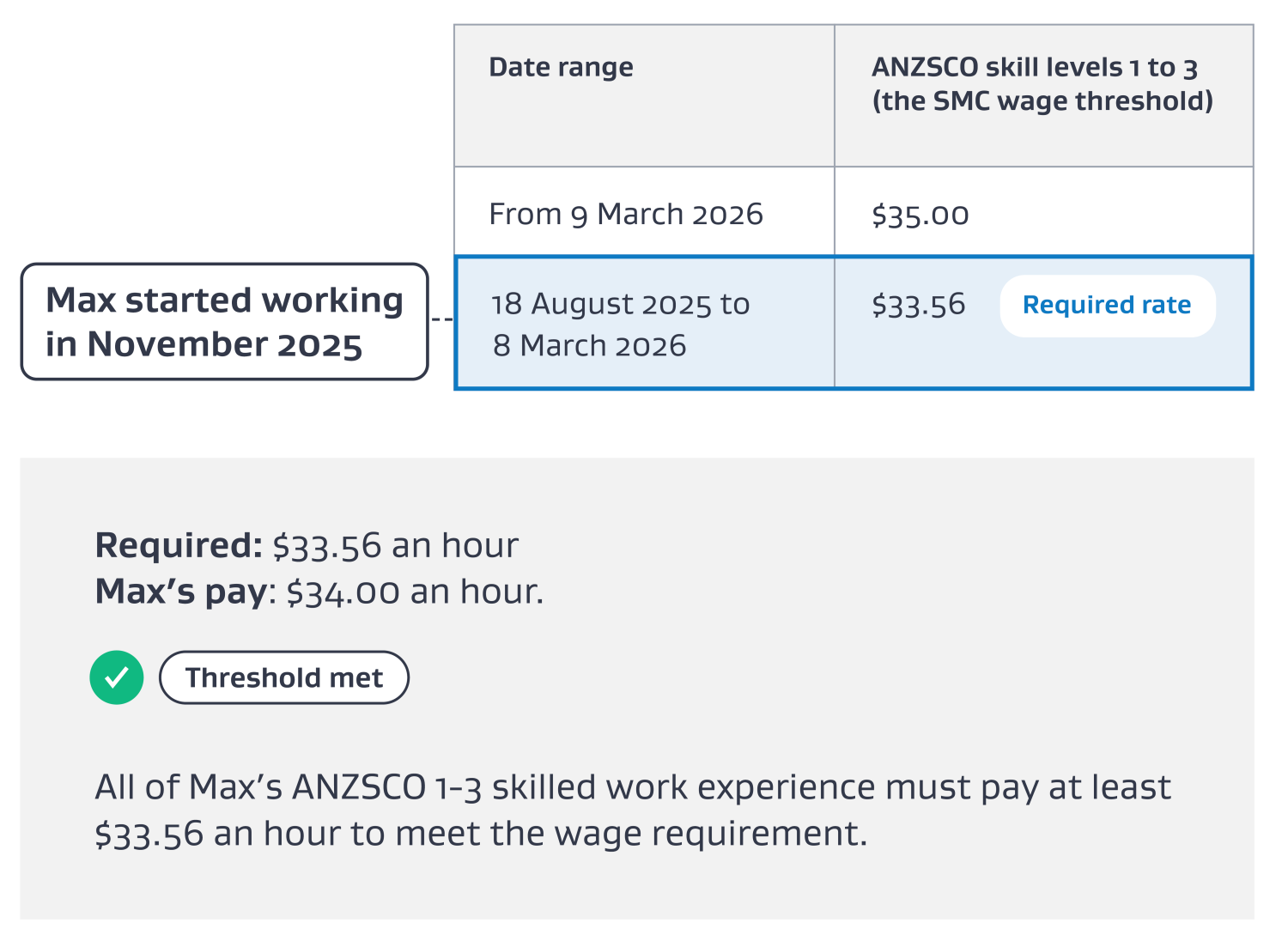
Max first started skilled work experience in November 2025, when he was paid NZD $34.00 an hour. The SMC wage threshold at the time was NZD $33.56 an hour.
Because Max earned more than the threshold, his skilled work experience can start counting from November 2025. His threshold is set at NZD $33.56 an hour.
Any further skilled work experience Max uses, and the current job or job offer he uses to apply, must pay at least NZD $33.56 an hour.
Example
Priya is applying under the Points-based pathway and wants to claim points for skilled work experience.
Priya has an ANZSCO skill level 1 to 3 job, which means she must earn at least the SMC wage threshold.
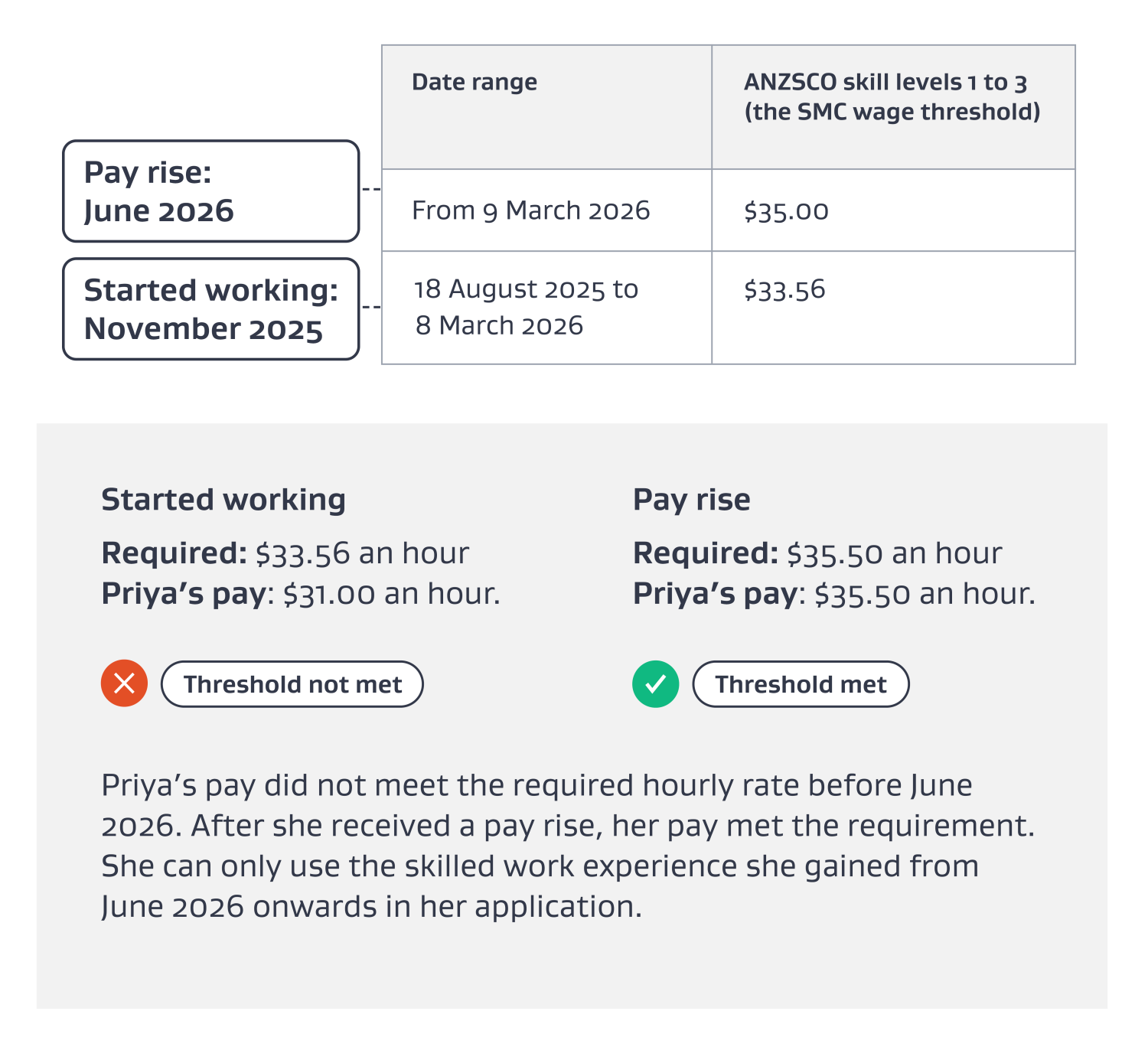
Priya started working in New Zealand in November 2025, when she was paid NZD $31.00 an hour. The SMC wage threshold at the time was NZD $33.56 an hour.
Because Priya earned less than the threshold, her skilled work experience could not start counting from November 2025.
In June 2026, Priya received a pay rise to NZD $35.50 an hour. The SMC wage threshold at that time was NZD $35.00 an hour.
Because Priya then earned more than the threshold, her skilled work experience can start counting from June 2026. Her threshold is set at NZD $35.00 an hour.
Any further skilled work experience Priya uses, and the current job or job offer she uses to apply, must pay at least NZD $35.00 an hour.
SMC wage threshold rates
These tables show SMC wage threshold rates by pathway. All pay rates are hourly and in New Zealand dollars (NZD).
The SMC wage threshold for some pathways can also depend on the ANZSCO skill level of your job.
Points-based pathway rates
| Claiming 6 points for a qualification | Claiming 6 points for an occupational registration | Claiming 6 points for income (3 times the SMC wage threshold) | |
|---|---|---|---|
| SMC wage threshold (ANZSCO skill levels 1 to 3) | $35.00 | $35.00 | $105.00 |
| 1.5 times the SMC wage threshold (ANZSCO skill levels 4, 5 or unlisted jobs) | $52.50 | $52.50 | Not applicable if claiming points for income |
| Date you started gaining skilled work experience in New Zealand | SMC wage threshold (ANZSCO skill levels 1 to 3) | 1.5 times the SMC wage threshold (ANZSCO skill levels 4, 5 or unlisted jobs or claiming 3 points for income) |
2 times the SMC wage threshold (Claiming 4 points for income) |
|---|---|---|---|
| From 9 March 2026 | $35.00 | $52.50 | $70.00 |
| 18 August 2025 to 8 March 2026 | $33.56 | $50.34 | $67.12 |
| 28 February 2024 to 17 August 2025 | $31.61 | $47.41 | $63.22 |
| 27 February 2023 to 27 February 2024 | $29.66 | $44.49 | $59.32 |
| 24 October 2022 to 26 February 2023 | $27.76 | $41.64 | $55.52 |
| 19 July 2021 to 23 October 2022 | $27.00 | $40.50 | $54.00 |
| 24 February 2020 to 18 July 2021 | $25.50 | $38.25 | $51.00 |
Trades and Technician and Skilled Work Experience pathway rates
| Date you started gaining skilled work experience in New Zealand |
SMC wage threshold (Trades and Technician pathway) |
1.1 times the SMC wage threshold (Skilled Work Experience pathway) |
1.2 times the SMC wage threshold |
|---|---|---|---|
| From 9 March 2026 | $35.00 | $38.50 | $42.00 |
| 18 August 2025 to 8 March 2026 | $33.56 | $36.91 | $40.27 |
| 28 February 2024 to 17 August 2025 | $31.61 | $34.77 | $37.93 |
| 27 February 2023 to 27 February 2024 | $29.66 | $32.62 | $35.59 |
| 24 October 2022 to 26 February 2023 | $27.76 | $30.53 | $33.31 |
| 19 July 2021 to 23 October 2022 | $27.00 | $29.70 | $32.40 |
| 24 February 2020 to 18 July 2021 | $25.50 | $28.05 | $30.60 |
Timeframe for setting your SMC wage threshold
There is a limit on how far back you can go when setting your SMC wage threshold.
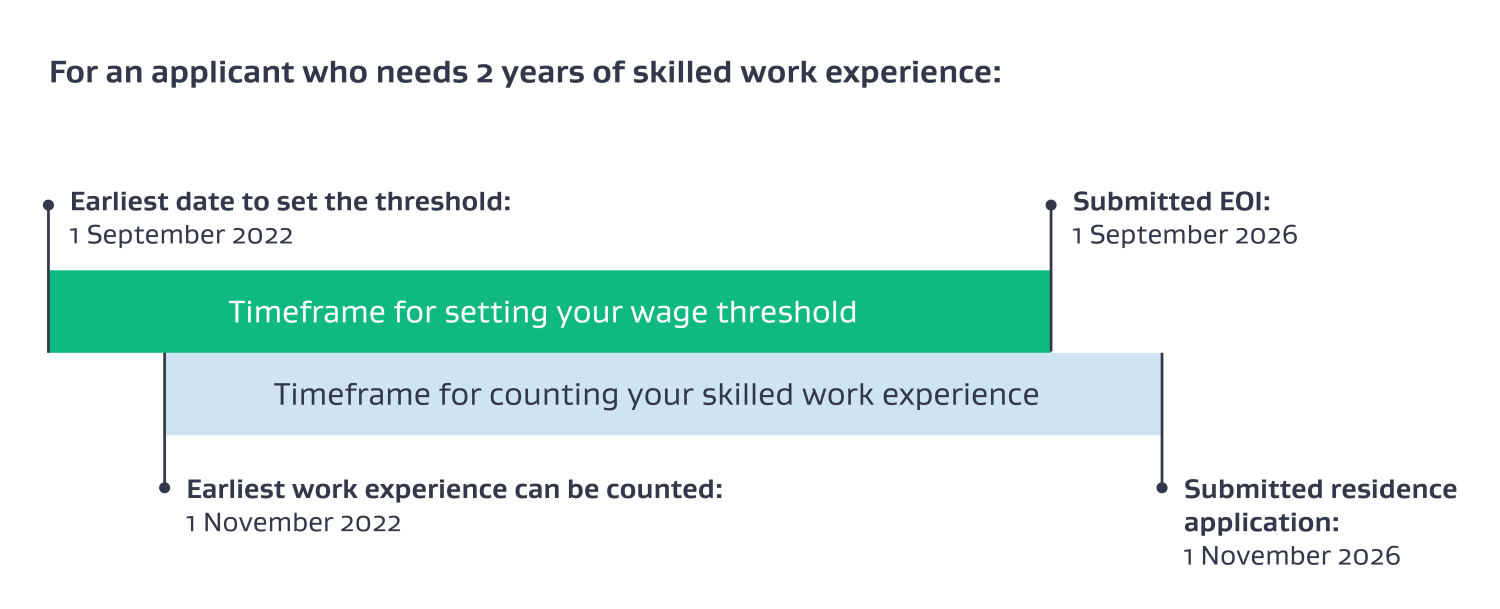
The skilled work experience used to set your threshold must be within the eligible timeframe for your pathway. This timeframe is twice the amount of skilled work experience you need, counted back from the date you submit your EOI.
For example, if you need 2 years of skilled work experience and you submit your EOI on 1 September 2026, the earliest you can set your threshold is 1 September 2022 (4 years before you submit your EOI).
Timeframe for counting skilled work experience
The timeframe used to set your wage threshold is different from the timeframe used to count your skilled work experience.
When setting your wage threshold, the eligible timeframe is counted back from the date you submit your EOI. However, the eligible timeframe for counting skilled work experience is counted back from the date you apply for residence.
This means you can continue gaining skilled work experience after submitting your EOI and before applying for residence.
Eligible timeframes for setting your wage threshold
| SMC pathway |
Required skilled work experience in New Zealand |
Eligible timeframe to set threshold |
|---|---|---|
| Points-based pathway, claiming 1 point for skilled work experience | 1 year | 2 years |
| Points-based pathway, claiming 2 points for skilled work experience | 1.5 years | 3 years |
| Points-based pathway, claiming 3 points for skilled work experience | 2 years | 4 years |
| Trades and Technician pathway | 1.5 years | 3 years |
| Skilled Work Experience pathway | 2 years | 4 years |
Example
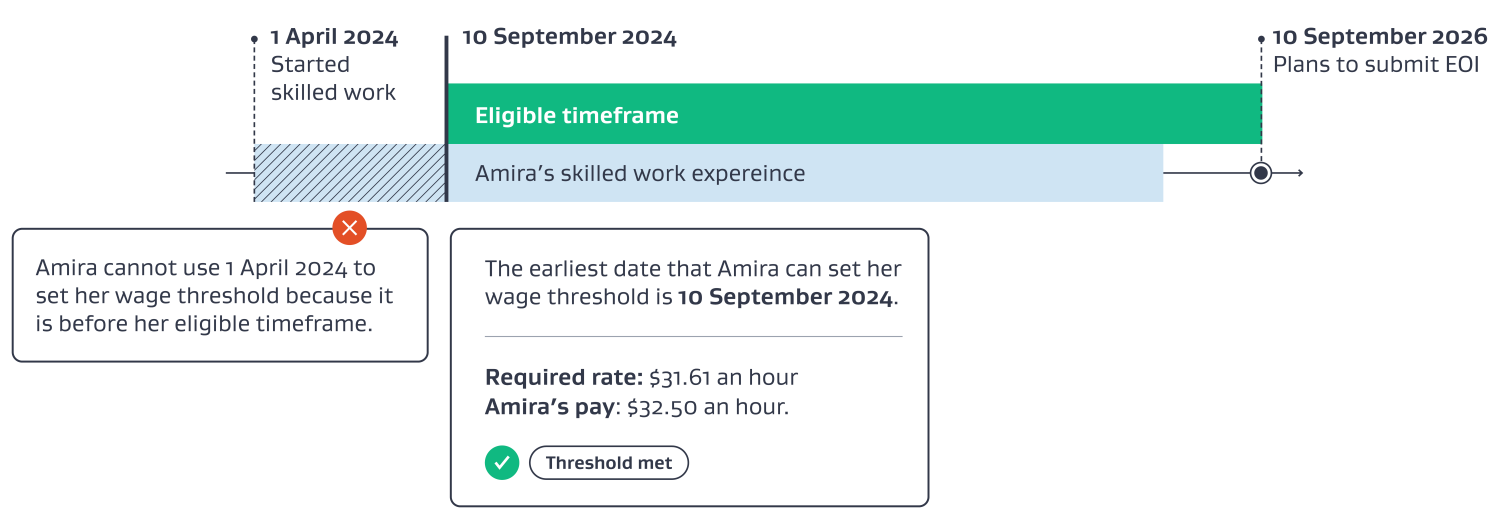
Amira wants to claim 1 point for skilled work experience under the Points-based pathway. This means she needs 1 year of skilled work experience within 2 years.
She plans to submit her EOI on 10 September 2026. Her eligible timeframe for setting her wage threshold is from 10 September 2024 to 10 September 2026.
Amira has skilled work experience from 1 April 2024 to 1 August 2026, and was paid NZD $32.50 an hour.
Because her eligible timeframe starts on 10 September 2024, she cannot use work experience before that date to set her wage threshold.
The SMC wage threshold on 10 September 2024 was NZD $31.61 an hour. Because Amira was earning more than this, her threshold can be set from the start of the eligible timeframe.
If you change jobs
For most people, you will not need to meet a higher SMC wage threshold if you change jobs during your skilled work experience.
You must continue to meet the threshold that was set when your skilled work experience first became eligible to count.
This includes if:
- you change employers, or
- you get a new position with the same employer.
If your pay drops below the threshold that applies to you, that work experience cannot count towards your SMC application.
Note
You may need to meet a higher SMC wage threshold if you are applying under the Points-based pathway and change jobs from an ANZSCO skill level 1 to 3 job to a skill level 4 or 5 job.
Grace period
In some cases, the SMC wage threshold may have increased between the date you received your work visa and the date you started gaining your skilled work experience. In these instances, there is a grace period that may allow you to meet the lower threshold that was in place when you received your work visa.
When it applies
The grace period applies if:
- you started gaining your skilled work experience within 5 months of your work visa being granted
- the SMC wage threshold increased between the date your work visa was granted and the date you started your skilled work experience
- your skilled work experience was within the eligible timeframe, and
- when you started your skilled work experience, you were paid at least the SMC wage threshold that was in place when your work visa was granted.
The grace period does not apply to a variation of conditions or an AEWV Job Change.
Example
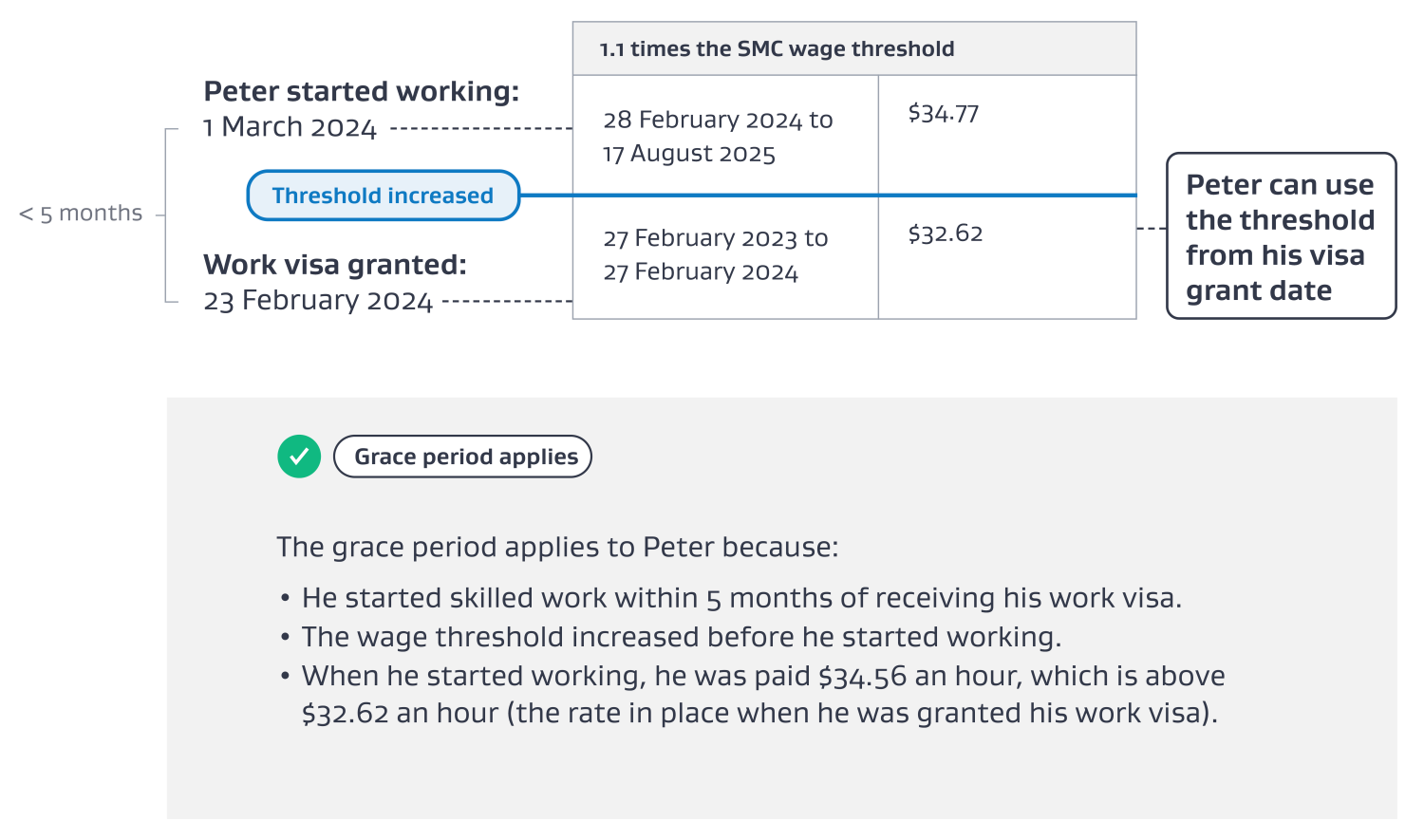
Peter is applying under the Skilled Work Experience pathway. His job is not on the Amber List, so he must be paid 1.1 times the SMC wage threshold.
He was granted his work visa on 23 February 2024. The threshold at this time was NZD $32.62 an hour.
Peter began working on 1 May 2024 and was paid NZD $34.56 an hour. The threshold at this time had increased to NZD $34.77 an hour.
Because Peter started working within 5 months of receiving his work visa, he only needs to meet the rate that was in place when his work visa was granted: NZD $32.62 an hour.
If your pathway depends on a qualification or registration
If you are applying through the Trades and Technician pathway, or you are claiming points for occupational registration under the Points-based pathway, only skilled work experience gained after you became qualified or registered can be counted.
This is because the qualification or registration is the point when you are recognised as skilled in that job.
Work experience gained before completing the relevant qualification or gaining the required occupational registration cannot be used towards the skilled work experience requirement.
- your current job or job offer must meet 3 times the SMC wage threshold in place when you submit your EOI
- your skilled work experience must meet 3 times the SMC wage threshold that applied when you started gaining that work experience.
You may need to meet a different wage rate if you are applying under the Points-based pathway (with a qualification or occupational registration) and your ANZSCO skill level changes during your skilled work experience.
This is because ANZSCO skill level 1 to 3 jobs must meet the SMC wage threshold, while ANZSCO skill level 4, 5 or unlisted jobs must be paid at least 1.5 times the SMC wage threshold.
The date your threshold is set does not change. However, the wage rate you must meet may be different if the ANZSCO skill level of your job has changed.
Example
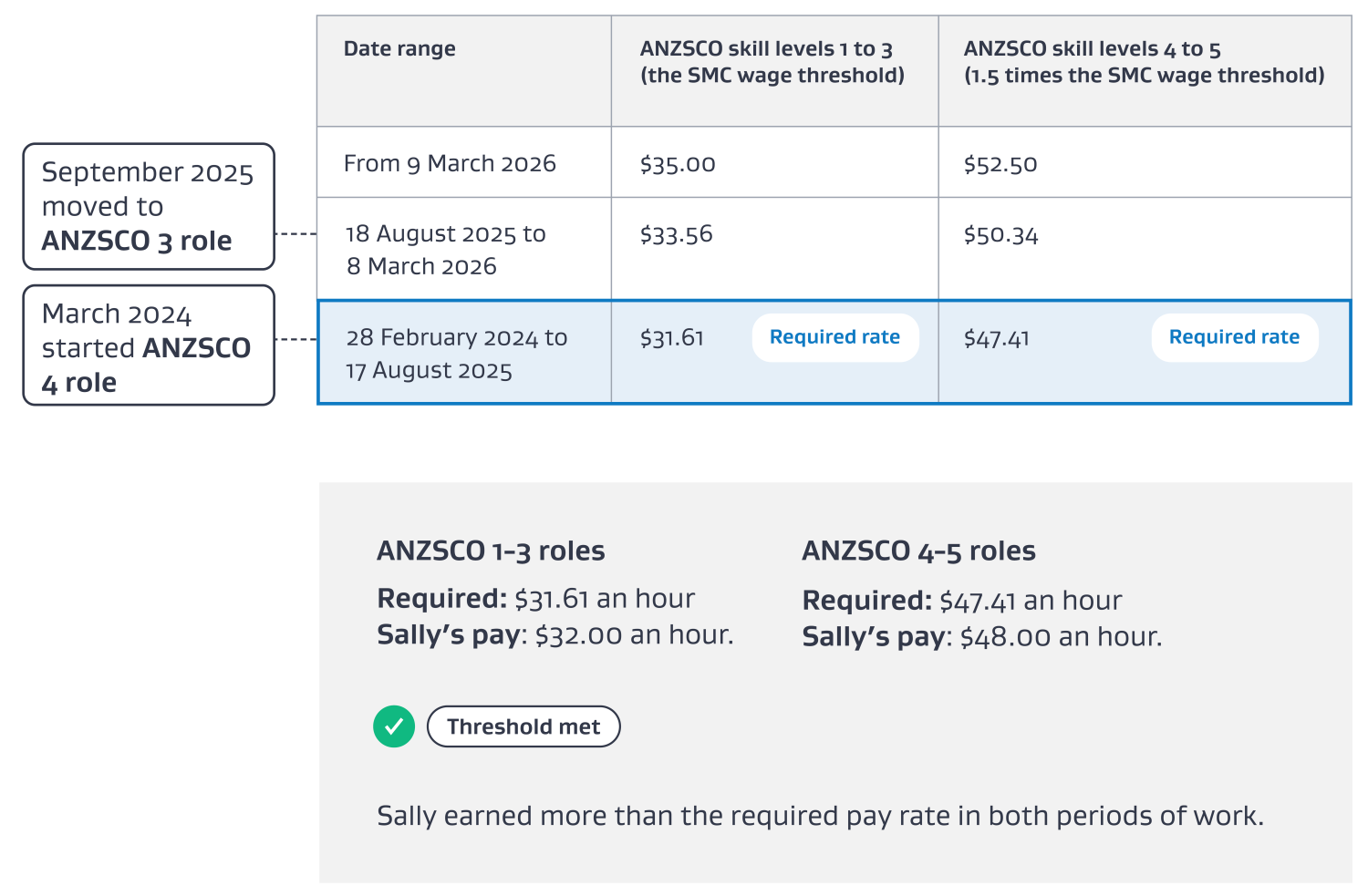
Sally is applying under the Points-based pathway.
She started working in an ANZSCO skill level 4 job in March 2024, earning NZD $48.00 an hour. At that time, 1.5 times the SMC wage threshold was NZD $47.41 an hour, so her work experience could start counting.
Sally later moved to an ANZSCO skill level 3 job in September 2025, earning NZD $32.00 an hour.
Because her threshold was set in March 2024, the wage rate for her ANZSCO skill level 3 job is based on the SMC wage threshold at that time. She must earn at least NZD $31.61 an hour for that work experience to count.
If your pay decreases below the threshold that was set for you, you cannot count that period of work experience.
If your pay later increases again, or you move to another job that pays at or above your threshold, your skilled work experience can start counting again from that point.
Example
Alex is applying for the Trades and Technician pathway. She needs 1 year and 6 months of skilled work experience.
She first started working on 1 February 2025 and was paid NZD $35.00 an hour. At the time, the SMC wage threshold was NZD $31.61 an hour.
Because Alex was paid above the threshold, her threshold was set at NZD $31.61 an hour.
On 5 November 2025, Alex started working for a new employer where she earned NZD $30.10 an hour. Because this is below the threshold set for her, she cannot count this period of work towards her application.
If Alex changes job again, or receives a pay rise that pays at least NZD $31.61 an hour, she can start counting skilled work experience again.
Breaks between jobs do not change your wage threshold if it has already been set.
However, your skilled work experience must still be completed within the eligible timeframe for your pathway. If too much time passes, some of your earlier skilled work experience may no longer be able to count.
If you are claiming 6 points under the Points-based pathway and are working under a contract for services, you need 1 year of skilled work experience.
Your skilled work experience and your current job or job offer may need to meet different wage rates:
| Date range |
3 times the SMC wage threshold (historical rates) |
|---|---|
| From 9 March 2026 | $105.00 |
| 18 August 2025 to 8 March 2026 | $100.68 |
| 28 February 2024 to 17 August 2025 | $94.83 |
Example
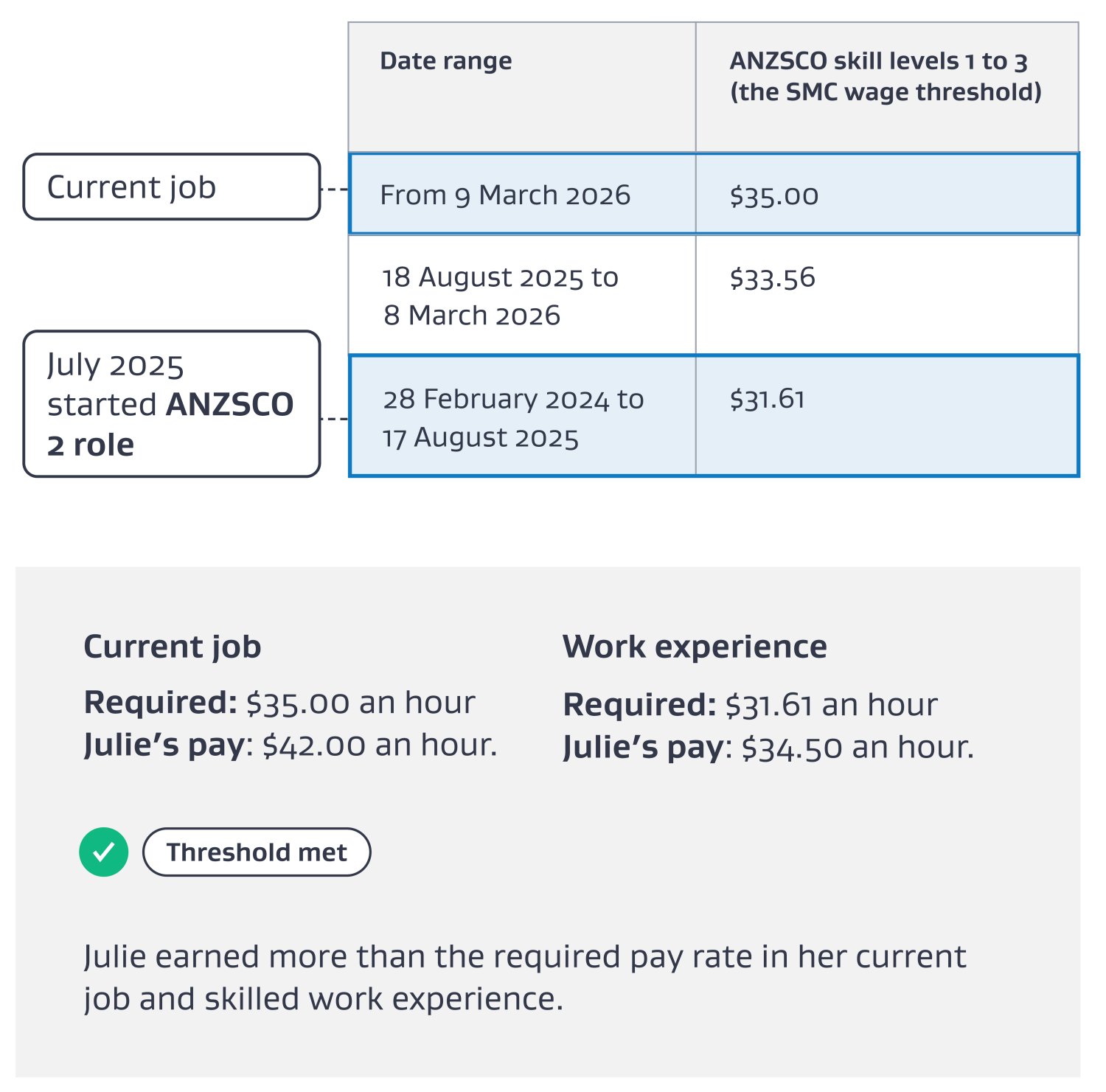
Julie is applying under the Points-based pathway and is claiming 6 points for her PhD. Her current job is a contract for services, so she needs 1 year of skilled work experience before she can apply.
She submits her expression of interest on 30 August 2026. Her current contract is in an ANZSCO skill level 2 job and pays NZD $42.00 an hour. The SMC wage threshold in place on the application date is NZD $35.00 an hour, so she meets the wage requirement for her current employment.
For her skilled work experience, she is using a prior 12-month contract that started on 30 July 2025. It is also an ANZSCO skill level 2 job and is paid NZD $34.50 an hour. At the time she started her contract on 30 July 2025, the threshold in place was NZD $31.61. As she was paid above that amount, her skilled work experience also meets the wage requirement.