
Providing accommodation for RSE workers
As a Recognised Seasonal Employer (RSE), you must provide accommodation to your workers that meets our minimum standards.
Note
From April 2026 weekly rent caps ranging from NZD $150 to NZD $211 will apply for RSE accommodation.
Accommodation for RSE workers
These are the minimum accommodation standards for Recognised Seasonal Employer (RSE) workers. Employers must meet these standards for health, safety, and compliance with their agreement to recruit (ATR).
Buildings
You must ensure accommodation buildings are permanent, weatherproof, and suitable.
This means:
- you cannot use caravans and tents as they are not suitable accommodation
- buildings must be soundly built from permanent and weatherproof materials
- new or renovated premises should comply with the Building Act 2004 and NZ Building Code
- buildings must be fully weatherproof, with gutters and downpipes
- interior walls should be lined and finished (timber-framed buildings)
- thermal insulation is required
- floors must be draught-proof, smooth, and easily cleanable (vinyl over concrete is recommended)
- foundation ventilation openings must be vermin-proof
- accommodation must be located away from stockyards, machinery, or chemicals
- buildings must be clean, hygienic, well maintained, and have adequate window coverings
- garages or non-habitable structures must not be used unless a building consent for change of use is granted.
Bedrooms
You must provide bedrooms that meet space and furnishing standards.
This means:
- provide a minimum floor space of 6 m² for 1 person, 9 m² for 2 people, plus 4.5 m² for each additional person, all with 2.4 m height
- bedrooms must have suitable beds, mattresses, and bedding (1 bed for each person)
- when sharing, occupants should be of the same gender unless agreed otherwise by the residents
- provide cupboards or wardrobes for clothes and personal items
- provide secure storage for valuables (either in the bedroom or in a separate locked and secure location on the property)
- bedding must be appropriate for regional and seasonal conditions (for example Central Otago in winter)
- for bedrooms with over 6 occupants, refer to the local territorial authority (city or regional council) building code as boarding house guidelines may apply
- bedroom capacity should be appropriate for long-term stays.
Cooking facilities
You must ensure cooking facilities are safe and adequate.
This means:
- facilities must be big enough for food preparation and sufficient for residents
- provide at least 1.5m clear floor space by the stove and sink
- supply suitable cooking equipment, utensils, and appliances
- provide hot water at the sink
- ensure adequate ventilation (window area more than 10% of floor space, at least half of the windows should be openable)
- provide cupboard space for non-perishable food and utensils
- cooking facilities must not be used as a bedroom.
Refrigeration
You must provide adequate refrigeration.
This means you must provide refrigerators and freezers with sufficient capacity for all residents.
Dining facilities
You must ensure dining facilities are comfortable and appropriate.
This means:
- provide dining rooms with at least 1.1 m² floor space for each person
- provide tables and enough seating for everyone at once (benches with backs acceptable, not fixed)
- supply adequate equipment, utensils, and appliances for dining
- dining rooms must not be used as bedrooms.
Casual recreational open space
You must provide communal open space.
This means you must provide sufficient open space (for example a lounge) appropriate to resident numbers.
Washing facilities
You must provide washing facilities for hygiene.
This means:
- provide sufficient hand basins with hot and cold water
- provide adequate baths or showers (at least 1 for every 7 people, your local territorial authority may specify more)
- each shower must have an attached dressing area of at least 1m²
- if there are no separate facilities for females, washing areas must be fully enclosed floor-to-ceiling with lockable doors.
Laundry facilities
You must provide enough laundry facilities for everyone.
This means:
- provide washing machines and laundry tubs
- provide enough space to dry clothes.
Sanitary conveniences
You must provide adequate toilet facilities.
This means:
- provide at least 1 bathroom and 1 flush toilet for every 7 people, the toilet must be lockable (however your local territorial authority may have further requirements depending on your accommodation type)
- if there are no separate toilet facilities for females, toilets must be fully enclosed floor-to-ceiling with lockable doors
- toilet capacity must match wastewater system capacity — you should upgrade if needed and check the building code
- you must ensure any on-site wastewater system is properly maintained, if a wastewater system breaks and the property becomes unsanitary it must be vacated until the system is repaired.
Water
You must provide safe and sufficient water supply.
This means:
- drinking water must meet New Zealand Drinking Water Standards and be clean and wholesome
- provide sufficient hot water for showers, baths, hand basins, laundry, and cooking
- water supply must meet New Zealand Building Code per-person requirements.
Lighting and ventilation
You must provide adequate lighting and airflow.
This means:
- all rooms should have natural and artificial lighting (minimum 75 lux for artificial lighting)
- window area must be at least 10% of floor space, and at least half of the windows must open
- ensure cross-ventilation where possible
- display “no smoking” signs at entrances and prohibit indoor smoking.
Heating
You must provide heating appropriate for climate.
This means:
- provide heating in at least 1 room (electric, flued gas, open fire, coal range, or space heater)
- portable unflued gas appliances are not acceptable
- heating must be appropriate for regional and seasonal conditions (for example Central Otago in winter).
Rubbish disposal
You must provide safe waste disposal.
This means:
- provide bins with tight-fitting lids, located away from accommodation
- ensure rubbish is disposed of to prevent health hazards or nuisance
- provide sufficient bins for all residents.
Fire safety
You must comply with fire safety standards.
This means:
- install smoke alarms in bedrooms and living areas compliant with the New Zealand Building Code
- provide fire protection (extinguishers, alarms, escape plans, notices) to meet local fire regulations.
For more information, refer to the 'INZ RSE accommodation standards' document:
Accommodation restrictions
Some restrictions apply for accommodation if the RSE workers are in:
- Bay of Plenty and Hawke's Bay, or
- Northland, Auckland (including upper Auckland), Marlborough, Nelson and Tasman, and Otago.
No other regions of New Zealand are affected by accommodation restrictions and the restrictions apply only to accommodation you are using for the first time.
If you are not sure where the property is located, check its legal address and council boundaries.
- the house was included in an ATR approved before 26 September 2019, or
- you own the house and bought it on or before 26 September 2019.
- rent a residential house you have not previously used to accommodate RSE workers, or
- buy a residential house after 26 September 2019 to accommodate RSE workers, even if you intend to significantly modify it.
- the house was included in an ATR approved before 26 September 2019, or
- you own it.
RSE workers must not live in a residential house unless:
You cannot:
RSE workers must not live in a residential house unless:
You cannot rent a residential house you have not previously used as accommodation for RSE workers. You can still buy a residential house, but the government expects you to offer purpose-built accommodation to RSE workers as soon as you can.
Types of housing you can offer instead
If you are not able to use a residential house due to your location, you can accommodate RSE workers in a:
- purpose-built seasonal worker accommodation
- converted or re-purposed property converted into seasonal worker accommodation
- house on a commercial orchard or vineyard, or
- guest accommodation, such as a designated boarding house, motels, homestay or billeting arrangement.
The existing quality guidelines for suitable accommodation assessed by the Labour Inspectorate will apply:
Healthy homes — Tenancy Services
Boarding houses — Tenancy Services
Types of tenancies — Tenancy Services
Rent caps for RSE accommodation
From April 2026 weekly rent caps ranging from NZD $150 to NZD $211 will apply. The amount you will be able to charge will depend on the quality and features of your accommodation. Characteristics such as the number of people sharing a bedroom, the age of the building, and bathroom proximity and type of access from bedrooms will determine the allowable rent.
Framework and guidance now available for RSE worker accommodation cost changes
RSE accommodation cost methodology
The following table explains how the accommodation cost caps will work.
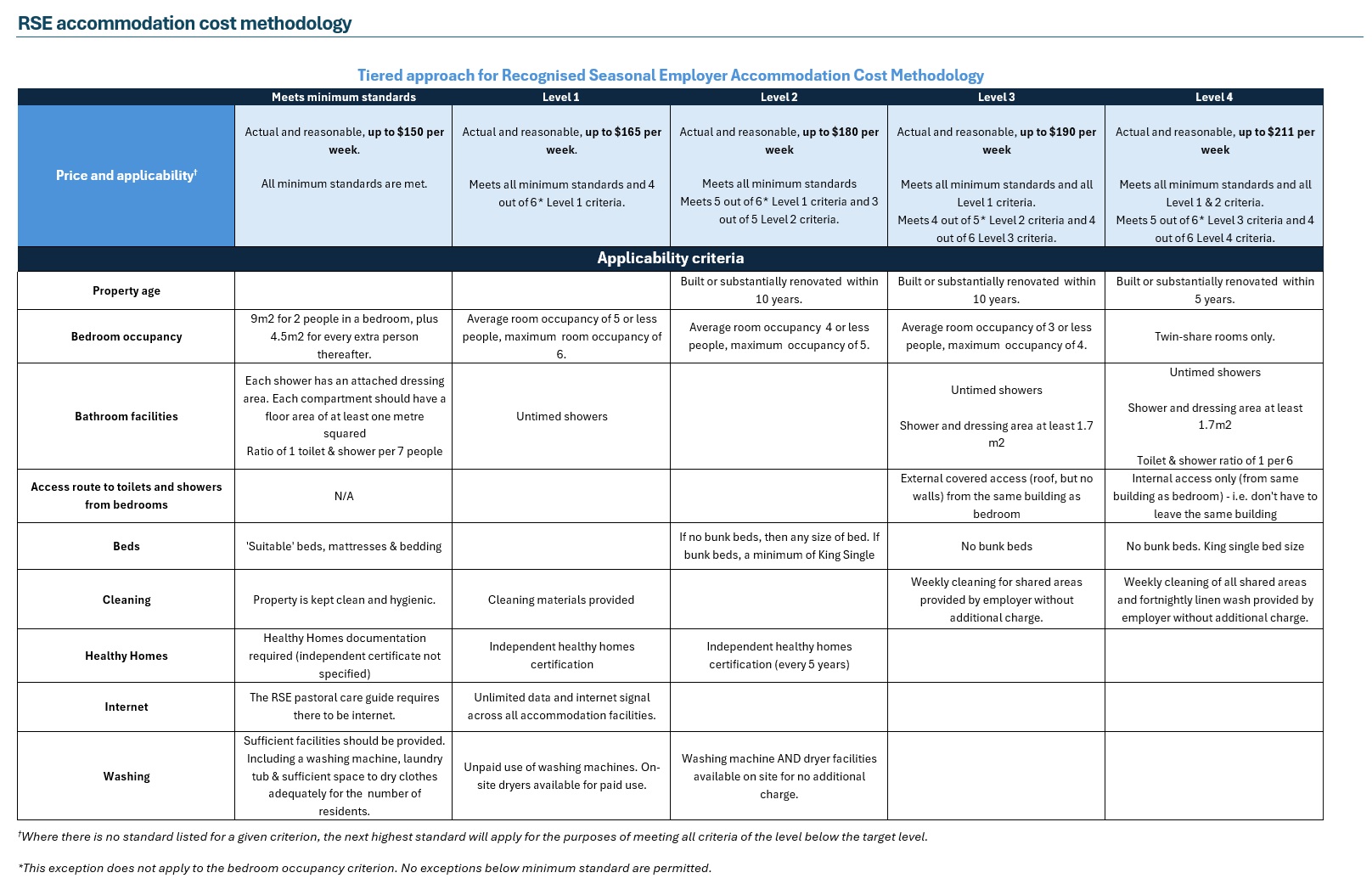
If a property does not meet all minimum standards for RSE accommodation then you cannot use it at all, no matter the rent price.
You can also find a text-only version of this table below.
- Level 2: Built or substantially renovated within 10 years.
- Level 3: Built or substantially renovated within 10 years.
- Level 4: Built or substantially renovated within 5 years.
- Minimum: 6m² for 1 person in a bedroom, 9m² for 2 people in a bedroom, plus 4.5m² for every extra person thereafter.
- Level 1: Average room occupancy of 5 or fewer people, maximum 6.
- Level 2: Average room occupancy of 4 or fewer people, maximum 5.
- Level 3: Average room occupancy of 3 or fewer people, maximum 4.
- Level 4: Twin-share rooms only.
- Minimum: Each shower has an attached dressing area. Each compartment should have a floor area of at least 1m². Ratio of 1 toilet and shower per 7 people.
- Level 1: Untimed showers.
- Level 3: Untimed showers; shower and dressing area at least 1.7m².
- Level 4: Untimed showers; shower and dressing area at least 1.7m²; toilet and shower ratio of 1 per 6 people.
- Minimum: Not applicable.
- Level 3: External covered access (roof, but no walls) from the same building as bedroom.
- Level 4: Internal access only (from same building as bedroom) — i.e., don’t have to leave the building.
- Minimum: ‘Suitable’ beds, mattresses and bedding.
- Level 2: If no bunk beds, then any size of bed. If bunk beds, a minimum of King Single.
- Level 3: No bunk beds.
- Level 4: No bunk beds; King Single bed size.
- Minimum: Property is kept clean and hygienic.
- Level 1: Cleaning materials provided.
- Level 3: Weekly cleaning for shared areas provided by employer without additional charge.
- Level 4: Weekly cleaning of all shared areas and fortnightly linen wash provided by employer without additional charge.
- Minimum: Healthy Homes documentation required (independent certificate not specified).
- Level 1: Independent Healthy Homes certification.
- Level 2: Independent Healthy Homes certification (every 5 years).
- Minimum: The RSE pastoral care guide requires there to be internet.
- Level 1: Unlimited data and internet signal across all accommodation facilities.
- Minimum: Sufficient facilities should be provided, including a washing machine, laundry tub and sufficient space to dry clothes adequately for the number of residents.
- Level 1: Unpaid use of washing machines; on-site dryers available for paid use.
- Level 2: Washing machine AND dryer facilities available on site for no additional charge.
Tiered approach for Recognised Seasonal Employer Accommodation Cost Methodology
Price and Applicability
Meets minimum standards
Actual and reasonable, up to $150 each week. All minimum standards are met.
Level 1
Actual and reasonable, up to $165 each week. Meets all minimum standards and 4 out of 6 Level 1 criteria.
Level 2
Actual and reasonable, up to $180 each week. Meets all minimum standards, 5 out of 6 Level 1 criteria and 3 out of 5 Level 2 criteria.
Level 3
Actual and reasonable, up to $190 each week. Meets all minimum standards and all Level 1 criteria, 4 out of 5 Level 2 criteria and 4 out of 6 Level 3 criteria.
Level 4
Actual and reasonable, up to $211 each week. Meets all minimum standards and all Level 1 and 2 criteria, 5 out of 6 Level 3 criteria and 4 out of 6 Level 4 criteria.
Applicability Criteria
Property age
Bedroom occupancy
Bathroom facilities
Access route to toilets and showers from bedrooms
Beds
Cleaning
Healthy Homes
Internet
Washing
Notes
Where there is no standard listed for a given criterion, the next highest standard will apply for the purposes of meeting all criteria of the level below the target level.
The employer must comply with the bedroom occupancy of the level they are applying for. This item must be one of the items selected and there are no exceptions.
General principles for RSE rent caps
- Actual and reasonable costs apply — employers must not charge more than the actual cost incurred, even if it is below the level cap. Price caps are maximums, and do not guarantee reasonableness.
- This framework is for immigration purposes only — it does not override obligations under laws like the Minimum Wage Act, Wages Protection Act and the Residential Tenancies Act (RTA). Compliance with all other applicable laws will remain the employer’s responsibility.
- Where other regulatory settings either require or prohibit certain activities, the pricing structure in the model remains applicable. For example, if landlords (in this case, employers) are required under the Residential Tenancies Act to maintain shared areas in a reasonable state of cleanliness in boarding house-type accommodation, then the provision of appropriate cleaning services can still be used as evidence for meeting Level 3 criteria. Similarly, if local by-laws prevent internal bathroom access, the applicability of Level 4 criteria would remain unchanged. The rationale is that if the feature is prohibited, the employer does not incur the cost of providing it, and therefore the pricing model remains unaffected.
- Rent caps for each level will be updated each year to account for future cost pressures. Increases in rent caps will be indexed against the Consumer Price Index.
- Where necessary, workaround measures are acceptable provided they uphold the intent of the framework. For example, if accommodation has pre-existing coin-operated laundry facilities that are impractical to remove, alternative approaches may be used to ensure laundry services are effectively provided free of charge. These could include offering laundry chits, placing a jar of coins in the laundry room, or adjusting rent to offset the typical cost of laundry.
Clarifications for bathrooms, beds, cleaning and Healthy Homes standards
Bathrooms
To meet the relevant standard all criteria in the relevant box must be met.
Beds
For the purposes of the 'no bunk beds' provisions in levels 2 to 4, the intent is to prohibit bunk beds only where they are used to sleep more than 1 person. If a bunk bed structure is provided but only used to accommodate 1 worker—either on the top or bottom bunk, but not both—this is still considered compliant with the 'no bunk beds' requirement.
Cleaning
For evidence towards level 3 or 4 in this category, cleaning (of shared areas) must be provided by the employer without additional charge to the worker. Cleaning cannot be completed by RSE workers themselves.
Healthy Homes standards
Nothing in this model overrides or alters the Healthy Homes standards for properties that are legally required to comply with them.
For properties outside the scope of Healthy Homes requirements, the same standards apply within the levels as if the property were subject to those requirements. For example, at level 1, the property must have an independent report verifying that the property meets the equivalent of the Healthy Homes standards. At level 2 this independent verification must happen every 5 years.